1. Executive Summary: Source the Safety Evidence
Battery safety is a commercial sourcing decision. For importers of rechargeable desk fans, portable pedestal fans and outdoor camping fans, a battery failure can interrupt deliveries, damage customer confidence and create recall exposure. Chemistry, pack design, manufacturing consistency and documentation all deserve review before purchase.
At Foshan Marmot Intelligent Technology Co., Ltd. (Marmotfans), we present our Series #19 nail penetration demonstration as one part of that review. This guide expands on Questions #19 and #20 in our B2B FAQ. It explains what the demonstration shows, how semi-solid-state technology may improve abuse tolerance, and which evidence buyers should request separately.
2. Series #19: What the Nail Penetration Demonstration Shows
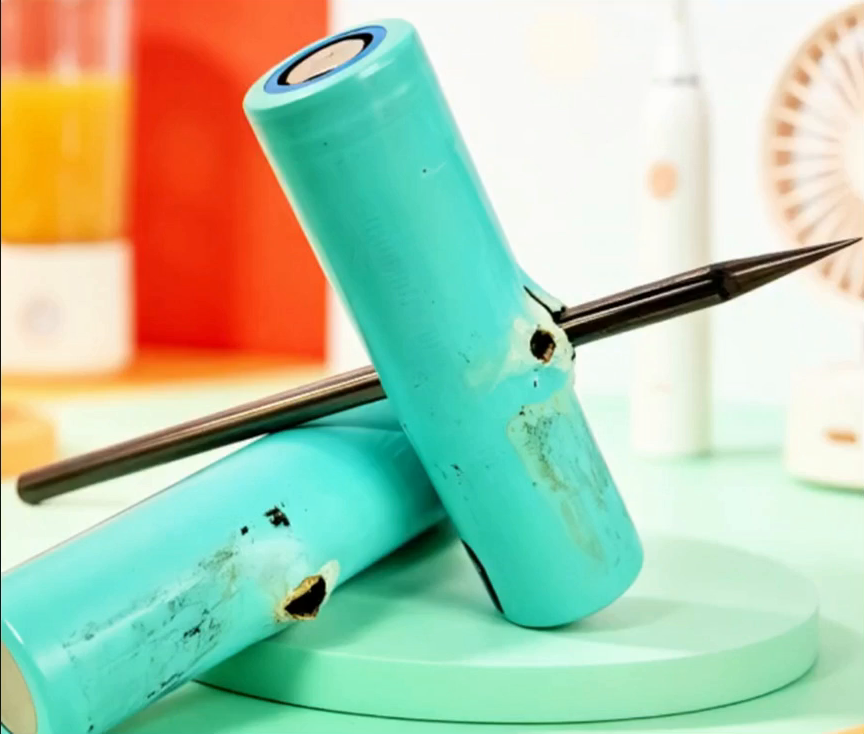
Our supplied video identifies the sample as an 18650 2000mAh semi-solid-state cell. It shows preparation in a penetration fixture, a closed test cabinet, an accelerated holding segment and the punctured cell afterward. The holding segment is labeled “5 minutes” and “10× playback.” No visible fire or explosion appears in the supplied sequence.[1]
For procurement review, distinguish these observations from instrumented results:
The stated method uses a steel nail at the cell’s center. A reproducible test record should specify penetration depth, hold time, monitoring positions and acceptance criteria, supported by sample identification and equipment records.
| Item | What buyers can establish |
|---|---|
| Sample identification | 18650 / 2000mAh, as identified in the video. |
| Hold duration | A five-minute hold is stated; the clip is approximately 61 seconds and includes accelerated footage. |
| Visible outcome | No visible fire or explosion; a puncture is visible afterward. |
| Measurements to request | Temperature and voltage traces, state of charge, nail dimensions, penetration speed and sample traceability. |
For OEM acceptance, review the released report and complete test records. The clip does not establish negligible temperature rise, stable internal structure or a controlled comparison with liquid-electrolyte cells. “Zero Thermal Runaway” should never become a universal product guarantee from this demonstration alone.
3. How Semi-Solid-State Designs Can Improve Abuse Tolerance
A nail penetration test deliberately creates mechanical damage that may cause an internal short circuit. Whether this develops into thermal runaway depends on the electrodes, separator, electrolyte, charge level and test conditions.
Some semi-solid or quasi-solid formulations immobilize liquid within a polymer or gel network. Depending on formulation, this can reduce leakage, improve thermal stability or change reactions at electrode interfaces. Published research demonstrates improved abuse tolerance in particular designs; those results cannot establish the composition or performance of our demonstration cell.[2]
Semi-solid-state does not mean nonflammable. Dendrite behavior and cathode oxygen release require their own evidence. Our semi-solid-state battery fan sourcing discussion therefore considers the complete battery system, including protection circuitry, charging control and enclosure design.
Ask the cell supplier to identify the electrolyte system and relevant abuse-test conditions. Compare candidate cells at matched charge levels and temperatures before attributing an observed result to the electrolyte alone.
4. Japan PSE and EU 2027: Separate Compliance Workstreams
What should a “Japan PSE Certified Battery” brief specify?
Verify the exact battery model, applicable DENAN classification, technical conformity evidence, importer responsibilities and labeling. Covered non-specified products use the circular PSE mark under a self-declaration framework. A nail penetration demonstration neither grants PSE status nor guarantees faster approval. Chemistry selection can support an engineering assessment, but it does not replace the applicable conformity process.[3]
EU 2027 removable battery design
Article 11 of Regulation (EU) 2023/1542 applies from 18 February 2027, subject to its scope and derogations. For covered portable batteries, plan user removal and replacement, compatible spare batteries, accessible instructions and safe reassembly. The obligation concerns the complete battery, not dismantling its individual cells. Semi-solid chemistry does not itself establish compliance.[4]
5. Applications and the Commercial Case
For premium desk fans, evaluate charging behavior during extended use. For rechargeable pedestal fans, review pack retention and mechanical loads. For outdoor camping fans, define operating temperatures, impact exposure and storage conditions. Each application needs configuration-specific validation.
If your planned retail position is US$40–100+, assess the battery upgrade alongside runtime, noise, finish and serviceability. Potential reductions in returns, unfavorable reviews or insurance exposure require pilot-order results, field data and insurer review. We recommend evaluating the total landed cost and warranty allowance rather than assigning an unverified safety premium.
6. Marmotfans Engineering and Document Control
As a B2B cooling fan factory in Foshan, we connect original private-mold product development with battery selection and OEM configuration review. Confirm the cell, pack, protection circuit, charger and replacement interface before approving production.
At sample approval, agree charging limits, protection behavior, replacement instructions and lot traceability. Production inspection should verify the approved details, with change control for cell suppliers, protection boards and packaging.
Request model-matched UN38.3 test summaries, applicable PSE evidence and IEC 62133-2 reports or CB certification records. Check the issuer, revision and covered configuration. SDS/MSDS documentation is not a transport certificate, and a CB record is not automatically UL certification. Battery design changes can affect test coverage; verify the agreed documents before shipment.[5] [6] [7]
Technical References and Evidence
- Marmotfans B2B Sourcing Series #19: supplied edited nail penetration demonstration, approximately 61 seconds. Reviewed 4 November 2026. The demonstration identifies the sample and labels a five-minute accelerated hold; it is not a released laboratory report.
- Chen et al., Energy Storage Materials (2024): Revealing the quasi-solid-state electrolyte role on the thermal runaway behavior of lithium metal battery. Research on other battery configurations; not validation of the demonstrated Marmotfans cell.
- METI: Electrical Appliances and Materials Safety Act. JQA: PSE framework, including the non-specified product self-declaration scheme.
- European Commission: Guidelines on removability and replaceability under Regulation (EU) 2023/1542, Article 11.
- IATA: Battery Guidance Document, revised for the 2026 regulations. Model-specific test summaries, design changes and the distinction between SDS documentation and transport requirements.
- IEC: IEC 62133-2:2017+AMD1:2021, portable lithium cell and battery safety.
- ANSI/USNC: The IECEE CB Scheme and recognition of safety test results.