1. Executive Summary: Buy the Airflow Experience
For importers and brands developing high-end desk fans, portable pedestal fans and rugged outdoor fans, motor selection affects sound, runtime and perceived quality. A well-engineered 3-phase BLDC motor fan can support smoother low-speed operation and premium positioning. A single-phase BLDC fan can remain a practical choice when cost, space and the required operating range favor simpler electronics.
Compare complete fans at equivalent airflow. Phase count alone does not establish acoustic performance, efficiency or durability. Request operating curves and an approved physical sample before committing to tooling or a purchase order.
2. Understand the Motor and Its Controller
120 electrical degrees describes phase displacement
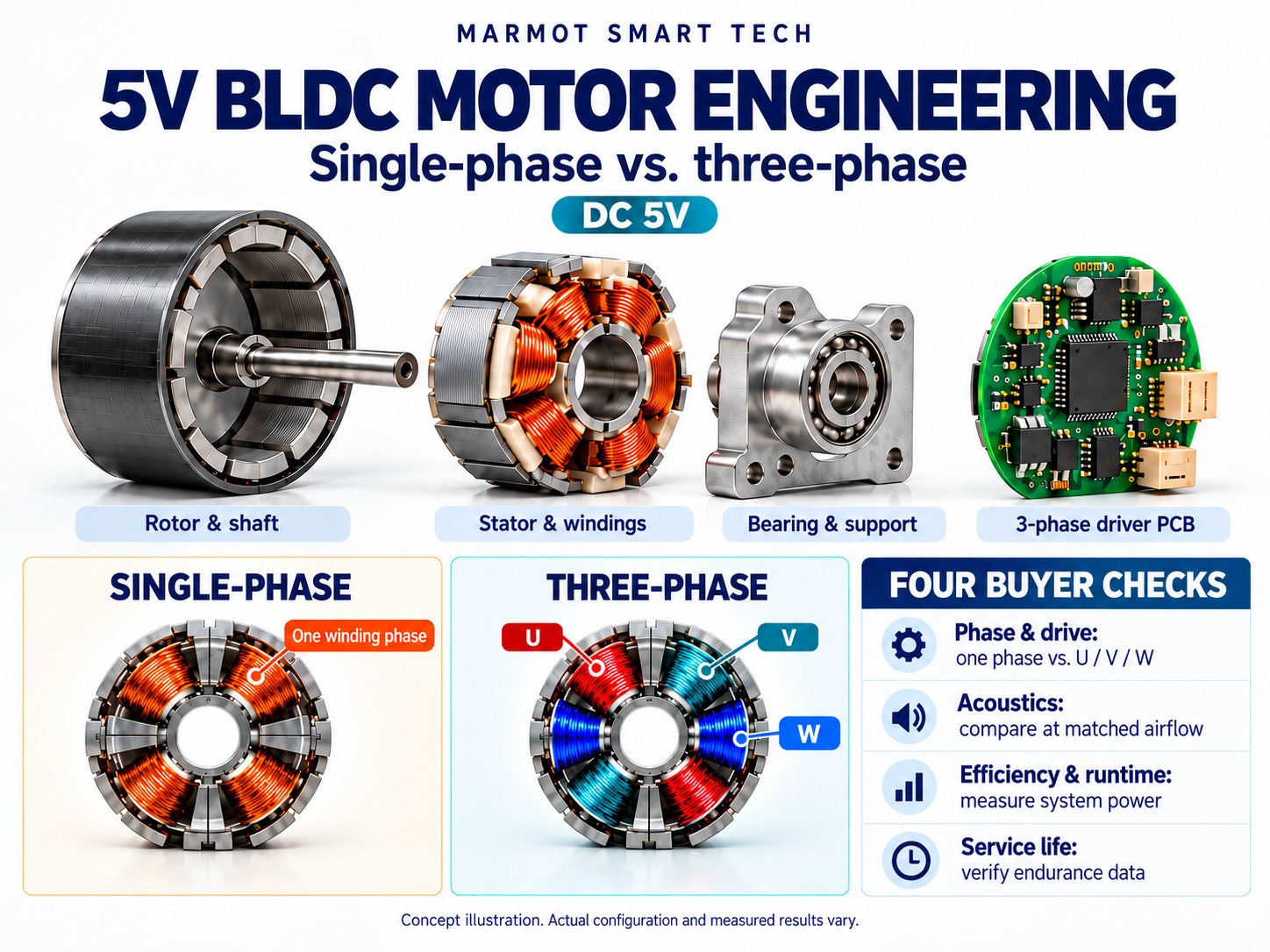
Three-phase windings are displaced by 120 electrical degrees. With suitable sinusoidal excitation, their magnetic fields create a smoother rotating field. A single-phase design reverses current through its winding circuit; geometry, rotor position and commutation strategy influence torque variation and starting behavior. The complete motor also includes permanent magnets, a rotor, bearings and mechanical support—not just coils.[1]
For a 5V DC-powered fan, “three-phase” describes internal motor excitation, not a requirement for mains three-phase power. Specify the battery voltage range, protection and any required regulation for the selected driver. Also distinguish phase displacement from conduction angle: a three-phase driver may use 180-degree sinusoidal drive. “120-degree sine versus 180-degree square” is therefore an unreliable purchasing shortcut.[2]
FOC reduces ripple; it does not guarantee silence
Field-Oriented Control (FOC) regulates current relative to rotor position. Correct tuning can reduce torque ripple and associated electromagnetic tones. Sinusoidal commutation is not automatically FOC. Treat “Zero Torque Ripple” as an idealized claim: sensing errors, cogging, bearings, blade loading and enclosure resonance still matter.[3]
3. Compare Five Purchasing Dimensions
| Dimension | 3-Phase BLDC | Single-Phase BLDC |
|---|---|---|
| Motor physics and drive | Three winding phases, 120 electrical degrees apart; sinusoidal or FOC control depends on the driver. | One electrical phase; waveform and switching refinement depend on the controller. |
| Acoustic profile | Smoother commutation can reduce tonal noise. Under 30 dBA requires a defined speed, airflow and test setup. | Not inherently 38–48 dBA. Evaluate the assembled fan under identical conditions. |
| Efficiency and runtime | Measure motor, driver and total system power separately; 80–90% is not a guaranteed architecture specification. | Do not assume a universal 60–70% efficiency baseline. Compare at matched airflow and supply voltage. |
| Operating life | No automatic 2–3× multiplier. Require bearing, thermal, endurance and start-stop evidence. | Life also depends on bearings, temperature, contamination, loading and protection. |
| Hardware and driver cost | Obtain an itemized motor-and-driver quotation; FOC, sensing and tuning affect cost. | Often simpler control, but validate the complete bill of materials rather than assuming a fixed cost ratio. |
For sample evaluation, hold the blade, grille and mounting arrangement constant while comparing motor options. Record DC voltage, current, input power, RPM, airflow and winding or driver temperature at each agreed speed. Repeat at relevant battery states of charge. This separates controller benefits from changes in impeller geometry or test conditions.
For an “under 30dB quiet fan” brief, record A-weighted sound pressure, microphone distance, background level, mounting, speed and delivered airflow. A quiet lowest-speed result does not describe maximum-speed operation.
4. Calculate Commercial ROI Before Paying a Premium
A planned US$30–80+ retail tier needs a convincing customer experience. If a quotation places three-phase motor hardware at 1.5–2.5× the single-phase alternative, calculate the actual per-unit difference alongside enclosure, battery, packaging, freight, channel margin and expected warranty costs. This multiple is a quotation scenario, not an industry price rule.
For illustration, a US$0.40 hardware premium across 5,000 units adds US$2,000. At US$25 per return, that equals 80 returns. These are planning assumptions; use your own service costs and pilot results to establish the break-even case.
For an outdoor camping fan, compare usable battery watt-hours and total electrical input at equal airflow. If measured input falls by 20% with unchanged usable battery energy, theoretical runtime rises by 25%. That calculation does not establish a blanket 15–25% improvement from changing phase count.
For a portable pedestal fan, include support-structure resonance and handling tests. Better motor control can address one source of complaints; reductions in RMA rates require pilot-order and field data.
5. Marmotfans: Integrate the Motor, Blades and Quality Plan
As a B2B cooling fan OEM manufacturer, Foshan Marmot Intelligent Technology Co., Ltd. develops original private-mold fans. Our V7 and new desktop air circulator pair three-phase BLDC motors with aluminum alloy blades. Anodized aluminum components provide additional finish options; blade alloy, coating and material certificates are configuration-specific.
Our engineering review considers the driver, blade geometry and assembly together. Where a project specifies FOC or a PWM carrier above 22 kHz, confirm the selected hardware, switching losses, temperature rise and EMC behavior. Raising frequency alone cannot remove every audible tone.[4]
Our Foshan operation handles structural engineering, prototype trials, final assembly and 100% finished-goods functional QC. Batch inspection follows ISO 2859-1, General Inspection Level II, with AQL 1.5 for major defects. Motor tuning and blade balancing involve specialist component partners; the agreed inspection plan defines balancing checks.